

NLP RP#05 (Communication Process, Preferred Representation Systems, and BMIR)
The Communication Process: Why Memory Distortion Is Natural
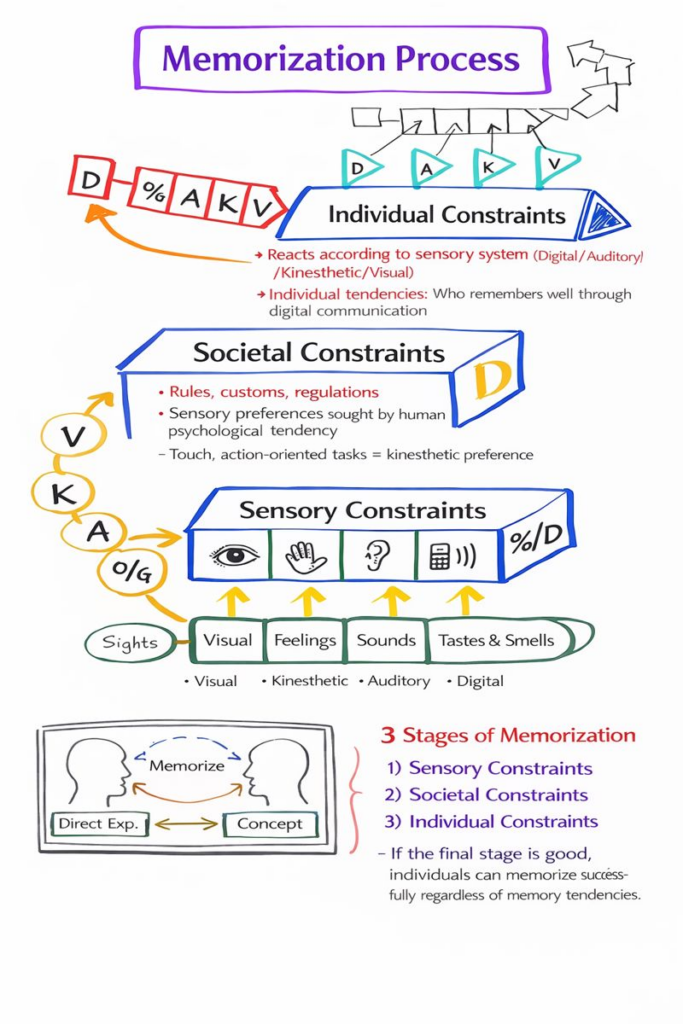
When we encounter an external event, we do not respond to it directly in NLP. Instead, the experience passes through several internal processes before it becomes our reaction. As external stimuli enter our system, they are first filtered through neurochemical limitations. Beyond these biological constraints, language, culture, and social frameworks apply additional layers of filtering. Finally, each individual’s preferred representation system transforms the information multiple times before it is stored in memory—often in a distorted form.
In short, memory distortion is not an error. It is a natural outcome of how human cognition works.
The diagram below highlights three major filters that information passes through before reaching the “memory box.”
Three Core Filters That Shape Our Perception
Neurochemical Constraints
We receive information through our five senses—sights, sounds, feelings, tastes, and smells—but our capacity is limited. From the very beginning, much of the information is automatically deleted.
Social Constraints
Language, culture, education, and relational norms frame how we interpret events. This is why the same words or behaviors can mean very different things depending on context.
Personal Constraints
Values, beliefs, past experiences, identity, and the preferred representation system (VAKD) combine to form our final interpretation. In other words, we do not perceive the event itself—we perceive our personal “map” of the event.
From External Event to Action: The NLP Flow
Although people may witness the same event, their interpretations often differ. The attached illustration explains this clearly through the concept of filters. An external event is never stored exactly as it is. Instead, it passes through multiple constraints, is transformed, and then saved in memory.
The overall process can be summarized as follows:
External Event → Filters → Internal Representation → State → Physiology → Action / Language
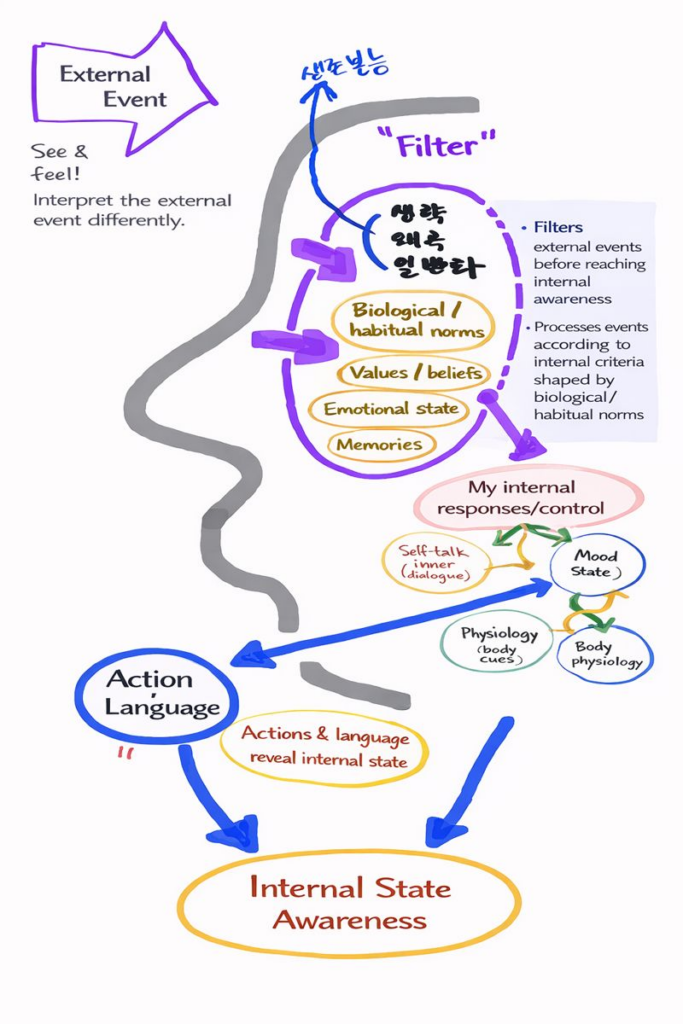
Our mental “filters” create internal representations. These representations influence emotional states and physiological responses, which then appear externally as behavior and language. For this reason, effective coaching does not aim to change the event itself, but rather helps clients examine and reshape the filters and representations through which the event is interpreted.
Behavior and language are never random. When internal representations shift, emotional states change, physiology adjusts, and communication patterns naturally follow. This is why, in coaching, observing language provides deep insight into a person’s internal state.
Preferred Representation Systems (VAKD): How People Experience the World Differently
A representation system refers to the sensory-based mental framework used to organize subjective experience. People tend to favor certain sensory channels both internally and in communication. This tendency is known as the Primary Preferred Representation System.
Visual (V): Image-oriented, fast-paced, quick to assess situations
Auditory (A): Sensitive to sound and rhythm, frequent self-talk
Kinesthetic (K): Body sensations and feelings, learns through physical experience
Digital (D): Logic, judgment, and analysis focused; intuition and sensory awareness may be reduced
In coaching, the key is not to label clients using diagnostic tools. Instead, coaches observe word choices, tone, speaking speed, eye movements, posture, and gestures to understand how the client is constructing their experience in the present moment.
Language Patterns and Predicates: How the Unconscious Speaks
Language reflects an individual’s internal model of the world. Word choices are selected unconsciously and expressed habitually. The most frequently used sensory-based words are called predicates.
Predicates—often verbs, adverbs, and adjectives—reveal habitual neurological thinking patterns operating beneath awareness. They provide direct insight into how a person organizes experience internally.
The BAGEL Model and BMIR: How Inner States Appear Externally
Internal states are expressed through physiology and behavior, reinforcing the NLP premise that mind and body function as one system. The BAGEL model provides a framework for observing psychological cues:
- Body Posture
- Accessing Cues
- Gestures
- Eye Movements
- Language Patterns
Meaningful human behavior originates from subtle internal changes that manifest externally. This concept is known as BMIR (Behavioral Manifestation of Internal Representation), referring to the outward signs of inner mental processes.
Careful observation of accessing cues often reveals a person’s preferred representation system.
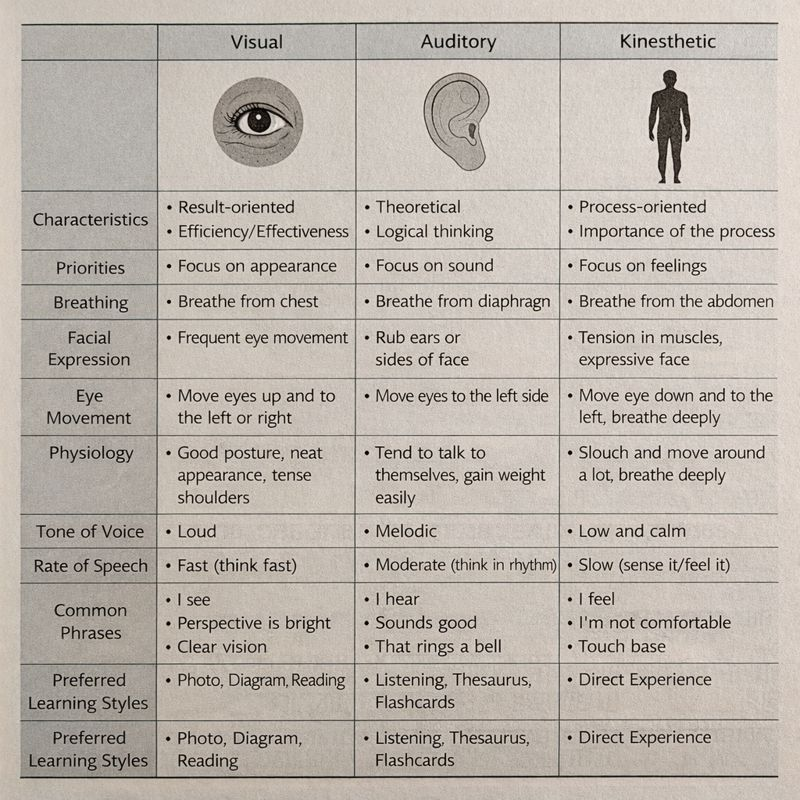
(Source: Principles of NLP for Change and Growth, Prof. Seong-Yeop Lee)
One particularly fascinating aspect is eye movement. Directional eye movements can offer clues about internal cognitive activity. For example, when a person’s eyes move upward to the right, they may be recalling visual memories, while upward to the left may indicate visual construction.
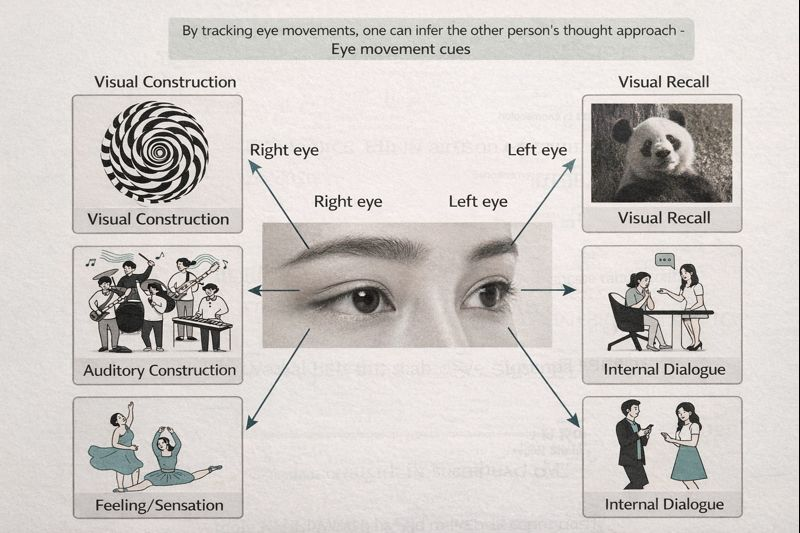
(Source: Principles of NLP for Change and Growth, Prof. Seong-Yeop Lee)
During online practice sessions, it was consistently observed that visual recall often triggered upward eye movements. This reinforced the idea that eye patterns can offer valuable insights into thinking processes.
Reflecting on My Preferred Representation System: Why K and D Stand Out
My assessment revealed the following order: Kinesthetic (29), Digital (28), Auditory (27), Visual (16). I enjoy hiking and am deeply moved by natural sounds—bird calls, footsteps, and wind brushing through trees. I also prefer direct physical interaction with nature, touching rocks and trees, and engaging my whole body in the experience. These tendencies strongly align with a Kinesthetic preference.
At the same time, my long career as a semiconductor and display process engineer required structured reasoning and analytical thinking. That logical comfort clearly reflects a strong Digital orientation.
This class clarified something essential: even when observing others, I interpret them through my own representation system. Moments when I instinctively read people through a Kinesthetic lens may not reflect objective truth, but rather my personal filter. Recognizing this distinction feels like a critical starting point for deeper, more ethical coaching.
기술과 마음이 교감하는 기록
For Your Dream Life
by Dream Max