
NLP RP #06 (The Four Stages of Growth and Resource Development)
The Four Stages of Growth in NLP Coaching:
Ma-eum, Rapport, and the Integration of Body and Mind
This reflection explores key insights from an NLP coaching class, focusing on the unity of body and mind (Ma-eum), the four stages of growth, and practical techniques for rapport building and resource development.
Ma-eum: A Word That Connects Body and Mind
One word left a particularly strong impression during the NLP class held on April 12, 2025: Ma-eum. It is a uniquely expressive term that conveys the idea that body and mind are not separate, but fundamentally one. Few words capture this concept as intuitively and concisely.
For a long time, body and mind had been treated as distinct entities in my thinking. However, this integrated perspective revealed something essential about the nature of human beings and the core philosophy of coaching. It reminded me that effective coaching begins with understanding the human being as a whole.
The class began with a fundamental question: What is a human being?
In exploring this question, I realized that many concepts I had taken for granted were, in fact, loosely defined and vaguely understood. Rather than searching for a single correct answer, the learning emphasized how meaning is shaped by how we define it ourselves. Learning, I realized, begins with the ability to remain comfortable in uncertainty and to accept not knowing.
Rapport and Presence-Based Coaching: Synchronizing Relationships
Rapport, an essential element of coaching, was revisited from a deeper perspective. Rapport is not merely about friendliness or surface-level connection; it is a process of synchronizing body and mind. When posture, energy, tone of voice, and rhythm align, people naturally feel safe and psychologically at ease.
A key technique for building rapport is mirroring. Matching a client’s gestures, vocal tone, speaking speed, and even breathing patterns according to their preferred representational system is not a mechanical skill, but an energetic exchange. This aligns with the core principle of NLP coaching: First pacing, then leading.
Only after genuine pacing—deeply matching and understanding the client—can a coach begin to lead toward change. Beyond verbal communication, this class reinforced the value of presence-based coaching, where the coach’s very way of being transmits energy and stability to the client.
The Four Stages of Learning and Growth: The Power of Attention
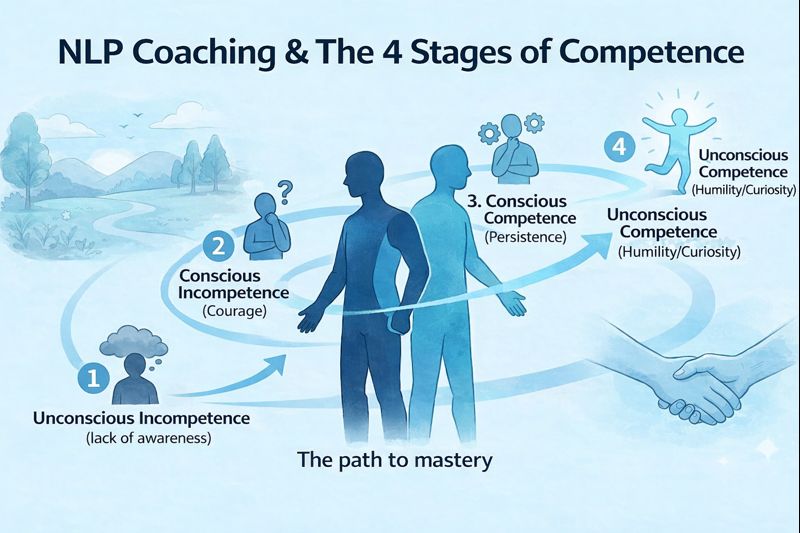
One of the central frameworks in this session was the four stages of learning, growth, and mastery. At the heart of this model lies attention. Sustainable growth depends on where and how attention is directed.
The four stages are:
- Unconscious Incompetence: Not knowing that one does not know. Curiosity is required.
- Conscious Incompetence: Recognizing one’s limitations. Courage is essential.
- Conscious Competence: Performing with focused effort. Persistence is needed. Often experienced as a “false plateau.”
- Unconscious Competence: Skills are embodied and expressed naturally. This stage requires humility and continuous curiosity.
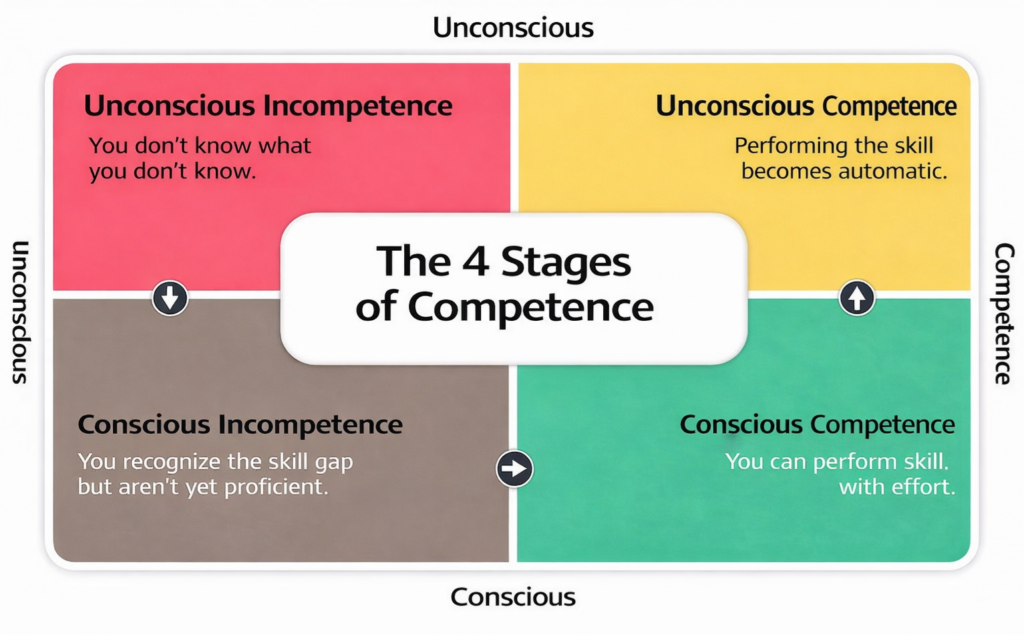
Especially during the conscious competence stage, progress may feel unstable—moments of confidence followed by setbacks. At these points, persistence becomes critical. Even at the highest level of unconscious competence, humility must be maintained to keep learning alive.
Transforming Failure into Learning
This framework resonated deeply with a recent personal experience. A few days before the class, I participated in a Coach-the-Coach session. Despite having earned my KAC certification, my performance felt disappointing. I had assumed I was more proficient than I truly was, and the result was a wave of self-doubt.
At the time, I interpreted this experience as embarrassment rather than learning. Through the NLP class, however, I came to see that I was simply in the stage of conscious incompetence. Not knowing and falling short are not sources of shame; they are invitations to grow. What is required in this stage is courage—the courage to remain steady regardless of external evaluation.
Recognizing this allowed me to reframe frustration as a meaningful signal that learning was actively taking place.
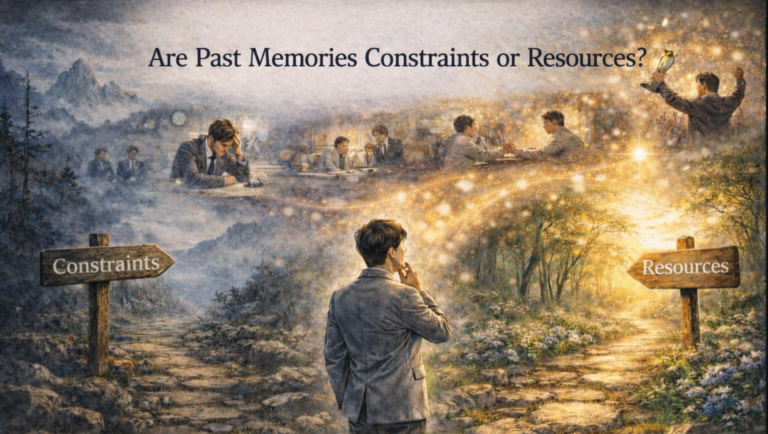
Resource Development: Bringing Positive Energy from the Past into the Present
In the afternoon session, we practiced resource development, a powerful NLP technique for accessing positive internal states. Resource development involves recalling past experiences rich with positive emotion and reconnecting with them through the senses (VAKOG: visual, auditory, kinesthetic, olfactory, gustatory).
The process begins by identifying a moment from the past when one felt joyful, confident, or fully alive. By carefully exploring the sensory details of that moment—what was seen, heard, felt, and experienced—the memory becomes vivid again. Human memory operates through the senses, and by reactivating them, the associated emotional energy returns.
Once accessed, this resource can be anchored to a specific cue, such as an object, gesture, or image. Later, recalling that anchor allows the same resourceful state to be accessed in the present. In this way, past strengths become usable energy for current challenges.
Through practice coaching with fellow coaches, I learned to listen deeply to others’ life stories and ask questions that helped uncover these hidden resources. Resource development proved to be a powerful coaching tool—one that allows individuals to draw strength from their own lived experiences.
A Journey of Change and Growth
Growth is not achieved in a single leap. It unfolds through continuous practice, guided by persistence, courage, and curiosity. While I am still in the process, I now recognize that the journey itself is learning. With this awareness, I continue to walk the path of coaching—quietly, steadily, and with respect for the process.
기술과 마음이 교감하는 기록
For Your Dream Life
by Dream Max